07 — Projects
Presente
Presente — a service that doesn't exist yet
Presente supports older people in Cali in two ways: a carer at home, always the same person, or a shared house of twelve to eighteen places. The service opens in 2027. So the site had to do something difficult: measure genuine interest without promising a place that doesn't exist yet.
Analysis
Three audiences, three motivations that don't overlap. Families in Cali looking for a solution now. Adult children living abroad, who decide at a distance and pay. And cuidadoras looking for work. A conventional brochure site serves one and loses the other two.
Before opening, a visit measures nothing. The only committing indicator is the qualified expression of interest: who you are, and what exactly you expect.
Design
One site for both forms. Moving from home care to the shared house is a family decision, not a change of supplier. The architecture places them side by side — one page per form, one shared page of commitments — so the switch doesn't mean starting over.
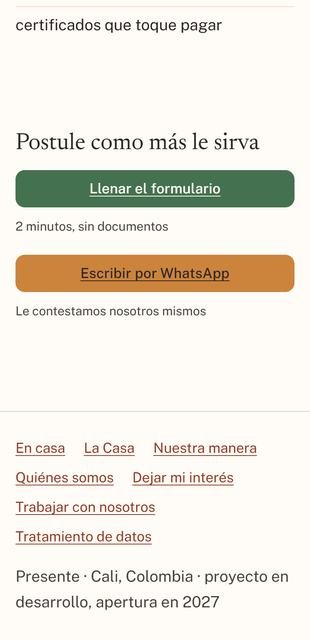
Mobile first, WhatsApp as the second channel. That is the real ground in Colombia, not a stylistic preference: form and conversation must be equally reachable, from the same screen.
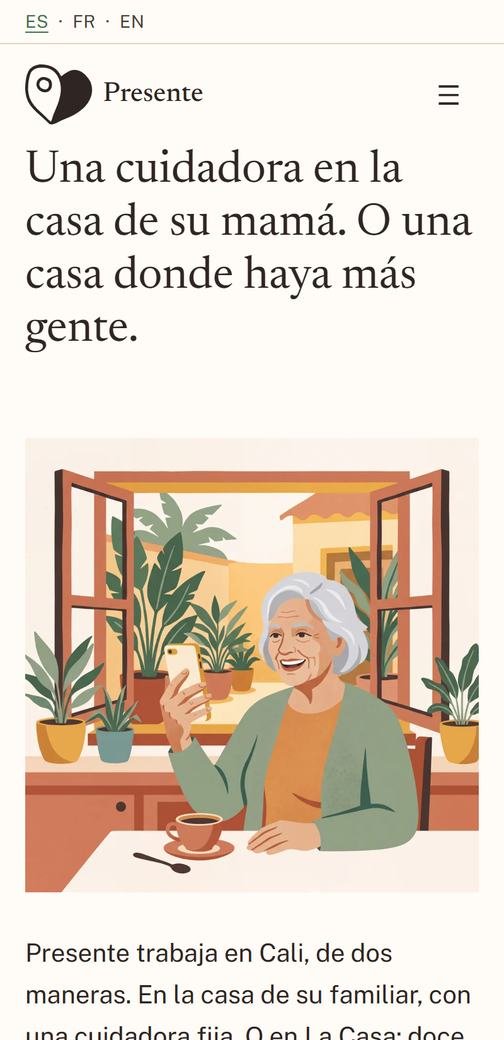
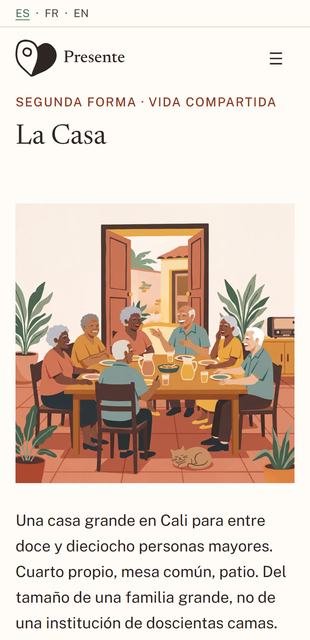
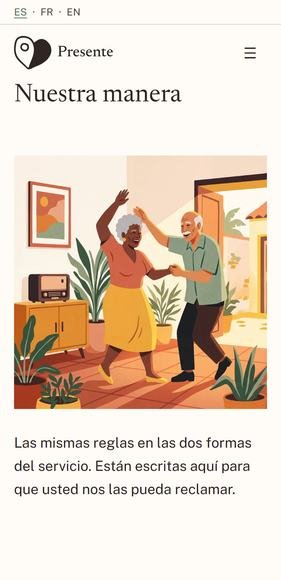
One form for three audiences
The first question asked — “Who are you?” — isn't administrative: it branches the three or four questions that follow. A family in Cali, an adult child abroad and a job applicant never have to answer the same things, and none of them should have to read the other two's questions.
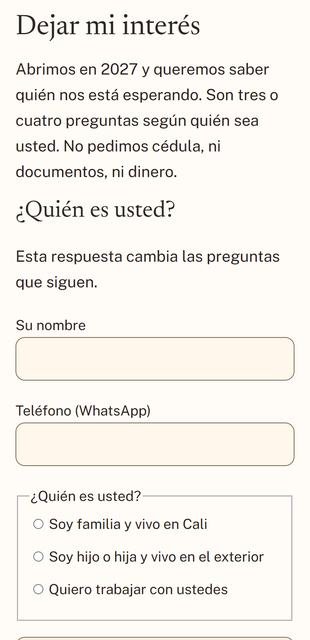
- No ID, no documents, no money — the sentence sits above the first field. In this market a form asking for the cédula reads as a risk, and the sentence that says so is worth more than one field fewer.
- “Two minutes, no documents” under the apply button: the duration is announced before the click, not discovered on the next screen.
- Commitments written to be claimed. One page states the service's rules, identical in both forms, and says explicitly that they exist to be held to.
- An opening “during 2027”, with no date and no address. Announcing less protects the launch: nothing to retract, and the wait stays honest.
Evaluation & iteration
The site is trilingual by structure, not by bolted-on translation: Colombian Spanish by default, French and English for the diaspora, with visitor language detection. The typefaces — a display serif and a reading sans — were chosen to hold up at large sizes: a share of the readers is over seventy.
Before opening, the deliverable isn't a website: it's a list of people waiting — and the proof that you know which ones.